


What is the manufacturing process of stainless steel equipment legs?
As a seasoned supplier of Stainless Steel Equipment Legs, I'm excited to share the detailed manufacturing process behind these essential components. Stainless steel equipment legs are widely used in various industries, from food processing to medical equipment, due to their durability, corrosion resistance, and aesthetic appeal. Understanding the manufacturing process can help customers appreciate the quality and value of these products.
Material Selection
The first step in manufacturing stainless steel equipment legs is selecting the right material. Stainless steel comes in different grades, each with its own unique properties. For equipment legs, we typically use grades such as 304 and 316 stainless steel. Grade 304 stainless steel is a popular choice due to its excellent corrosion resistance and affordability. It contains 18% chromium and 8% nickel, which gives it a shiny finish and makes it suitable for most applications. Grade 316 stainless steel, on the other hand, is more expensive but offers superior corrosion resistance, especially in harsh environments. It contains molybdenum, which enhances its resistance to pitting and crevice corrosion.
Once the appropriate grade of stainless steel is selected, the raw material is sourced from reputable suppliers. The material is inspected to ensure it meets the required specifications, including chemical composition, mechanical properties, and surface finish.
Cutting and Shaping
After the material is selected, the next step is to cut and shape it into the desired form. This is typically done using cutting tools such as saws, lasers, or plasma cutters. The cutting process must be precise to ensure the dimensions of the equipment legs are accurate.
Once the material is cut to the appropriate length, it is shaped using various techniques. For straight legs, the material may be bent using a press brake. For more complex shapes, such as flared tops or curved legs, specialized forming tools may be used. The shaping process requires skilled operators to ensure the legs are formed correctly and have a smooth finish.
Welding
In some cases, stainless steel equipment legs may require welding to join different components together. Welding is a critical process that requires careful attention to detail to ensure the integrity of the weld. The type of welding used depends on the application and the thickness of the material. Common welding methods for stainless steel include TIG (tungsten inert gas) welding and MIG (metal inert gas) welding.
TIG welding is a precise and clean welding method that is often used for thin materials or applications where a high-quality weld is required. It uses a non-consumable tungsten electrode to create an arc, and a filler metal is added to the weld pool as needed. MIG welding, on the other hand, is a faster and more efficient welding method that is suitable for thicker materials. It uses a consumable wire electrode that is fed through a welding gun, and a shielding gas is used to protect the weld from oxidation.
After welding, the welds are inspected to ensure they are free of defects such as cracks, porosity, or incomplete fusion. Any defects are repaired before the legs are further processed.
Machining
Once the legs are cut, shaped, and welded, they may require machining to achieve the desired surface finish and dimensions. Machining processes such as turning, milling, and drilling are used to remove excess material, create holes, and smooth the surface of the legs.
Turning is a process where the material is rotated against a cutting tool to remove material and create a cylindrical shape. Milling is a process where a rotating cutter is used to remove material from the surface of the material. Drilling is a process where a drill bit is used to create holes in the material.
Machining requires precision and accuracy to ensure the legs meet the required specifications. The use of advanced machining equipment and skilled operators is essential to achieve high-quality results.
Surface Treatment
After machining, the stainless steel equipment legs are typically subjected to surface treatment to enhance their appearance and corrosion resistance. Common surface treatments for stainless steel include polishing, passivation, and electroplating.
Polishing is a process where the surface of the legs is smoothed and buffed to create a shiny finish. This not only improves the appearance of the legs but also makes them easier to clean and maintain. Passivation is a chemical treatment that removes free iron from the surface of the stainless steel, which helps to prevent corrosion. Electroplating is a process where a thin layer of metal is deposited on the surface of the legs to improve their corrosion resistance and appearance.
The choice of surface treatment depends on the application and the customer's requirements. For example, in food processing applications, a polished finish may be preferred to ensure easy cleaning and prevent the accumulation of bacteria. In outdoor applications, a passivated or electroplated finish may be more suitable to protect the legs from corrosion.
Quality Control
Throughout the manufacturing process, strict quality control measures are implemented to ensure the stainless steel equipment legs meet the highest standards of quality. Quality control begins with the inspection of the raw materials and continues through each stage of the manufacturing process.

Inspection methods include visual inspection, dimensional measurement, and non-destructive testing. Visual inspection is used to check for surface defects such as scratches, dents, or discoloration. Dimensional measurement is used to ensure the legs meet the required specifications for length, diameter, and other dimensions. Non-destructive testing methods such as ultrasonic testing, magnetic particle testing, and liquid penetrant testing are used to detect internal defects such as cracks or porosity.
Any legs that do not meet the quality standards are rejected and either reworked or scrapped. This ensures that only high-quality legs are delivered to the customers.
Assembly and Packaging
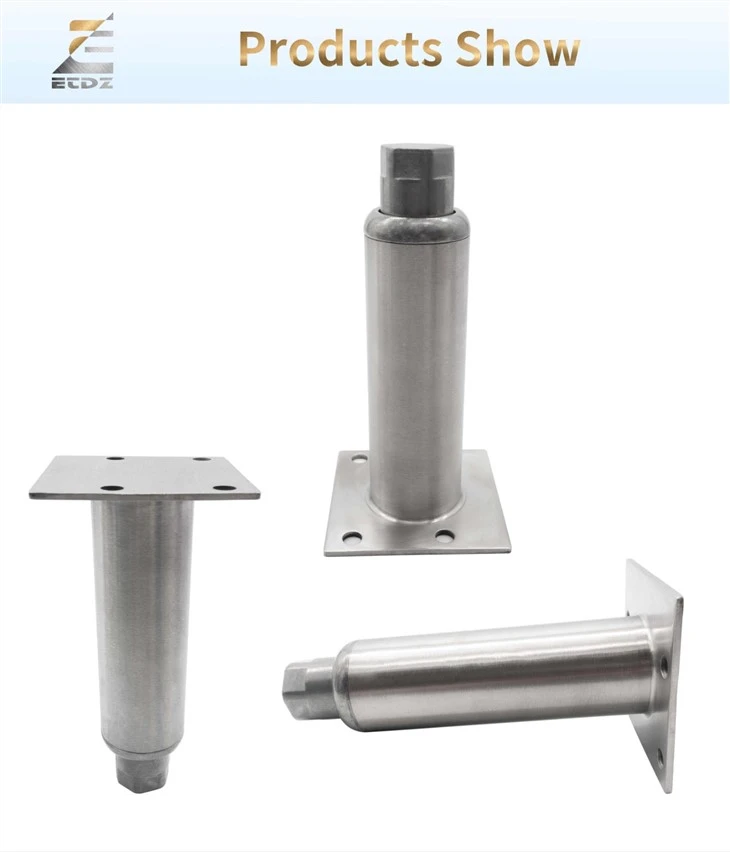
Once the stainless steel equipment legs have passed the quality control inspection, they are ready for assembly and packaging. Depending on the customer's requirements, the legs may be assembled with other components such as mounting plates or casters.
After assembly, the legs are carefully packaged to protect them during shipping and storage. The packaging materials used are selected to provide adequate protection and prevent damage to the legs.
Conclusion
The manufacturing process of stainless steel equipment legs is a complex and multi-step process that requires careful attention to detail and the use of advanced manufacturing techniques. From material selection to quality control, each step plays a crucial role in ensuring the production of high-quality legs that meet the customer's requirements.
As a supplier of Stainless Steel Equipment Legs, we are committed to providing our customers with the highest quality products at competitive prices. We use the latest manufacturing technology and equipment, and our skilled workforce ensures that every leg is produced to the highest standards of quality.
If you are in the market for stainless steel equipment legs, we invite you to explore our range of products. We offer a wide variety of Stainless Steel Security Equipment, Stainless Steel Flared Top Equipment Leg, and Equipment Leg with Mounting Plate Hex Toe. Our products are designed to meet the diverse needs of our customers in various industries.
Contact us today to discuss your requirements and learn more about how we can provide you with the best stainless steel equipment legs for your application. We look forward to working with you.
References
- ASM Handbook, Volume 13A: Corrosion: Fundamentals, Testing, and Protection. ASM International.
- Stainless Steel: A Practical Guide. K. C. Lippert. ASM International.
- Welding Metallurgy and Weldability of Stainless Steels. John C. Lippold and David J. Kotecki. Wiley.